
Ceramic vs Hybrid Ceramic Bearings: When to Use Which
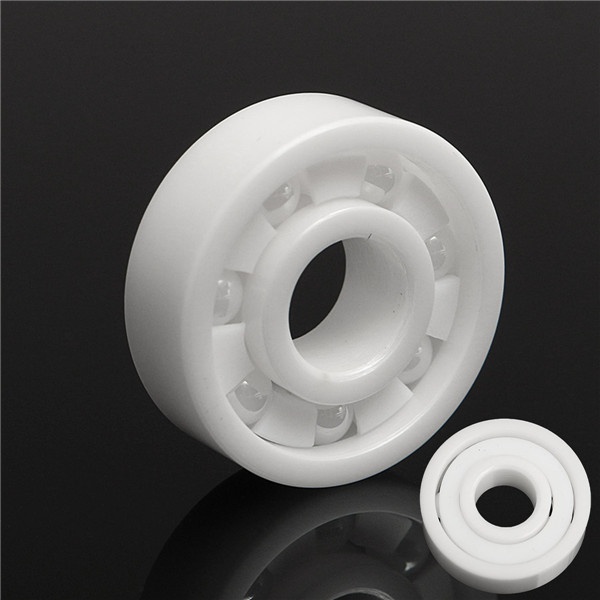
“Ceramic bearing” covers two quite different products: a full ceramic bearing, rings and balls in zirconia (ZrO2) or silicon nitride (Si3N4), and a hybrid, with Si3N4 balls running in steel rings. They solve different problems. This guide matches each construction to the failure mode it actually fixes.
Choose full ceramic when the environment attacks steel
Full ceramic bearings are corrosion-proof, non-magnetic and electrically insulating, and they can run in water and chemicals — and, grade-dependent, at high temperature with little or no lubricant. That makes them the answer for pumps and food and chemical machinery where steel rusts, semiconductor and medical equipment where magnetism and contamination are disqualifying, and washdown or marine positions where grease is washed away. If your steel bearing failed by corrosion, a hybrid — whose rings are still steel — does not fix the root cause; full ceramic does.
Choose hybrid when the problem is speed, life or current — in a standard envelope
A hybrid keeps the standard boundary dimensions and steel rings of the bearing it replaces, and upgrades the rolling elements: Si3N4 balls are lighter and harder than steel balls, so the bearing runs faster and cooler with lower friction and longer grease life, and the ceramic balls insulate electrically — which is why hybrids are also a shaft-current solution in smaller motors. Machine-tool spindles, high-speed motors and instruments are the classic hybrid applications, in precision grades up to P4. If your steel bearing failed by fatigue, heat or speed limits rather than by its environment, the hybrid is usually the direct, drop-in upgrade.
Inside full ceramic: ZrO2 or Si3N4?
Both NKEN full-ceramic materials are supplied across the standard 62/63 dimension series. Si3N4 is harder and lighter, and rated for higher speeds and temperatures — the performance choice. ZrO2 is the economical choice for corrosion resistance and insulation at moderate speeds. Cages are PTFE, PEEK or ceramic according to the application, so tell us the medium, temperature and speed and the material and cage are specified together.
A quick decision table
- Corrosion, chemicals, water, washdown → full ceramic.
- Non-magnetic or lubricant-free running → full ceramic.
- Higher speed, lower friction, longer grease life → hybrid.
- Shaft-current insulation in a standard motor size → hybrid, or a coated insulated bearing — our insulated bearings guide compares the two.
- Spindle precision up to P4 → hybrid, or full Si3N4 where the environment also demands it.
Next step: the ceramic bearings page lists the standard sizes in all three constructions — full ZrO2, full Si3N4 and hybrid — which interchange directly with the steel bearing of the same number. Send the size and the failure you are solving, and we recommend the construction with the quotation.